

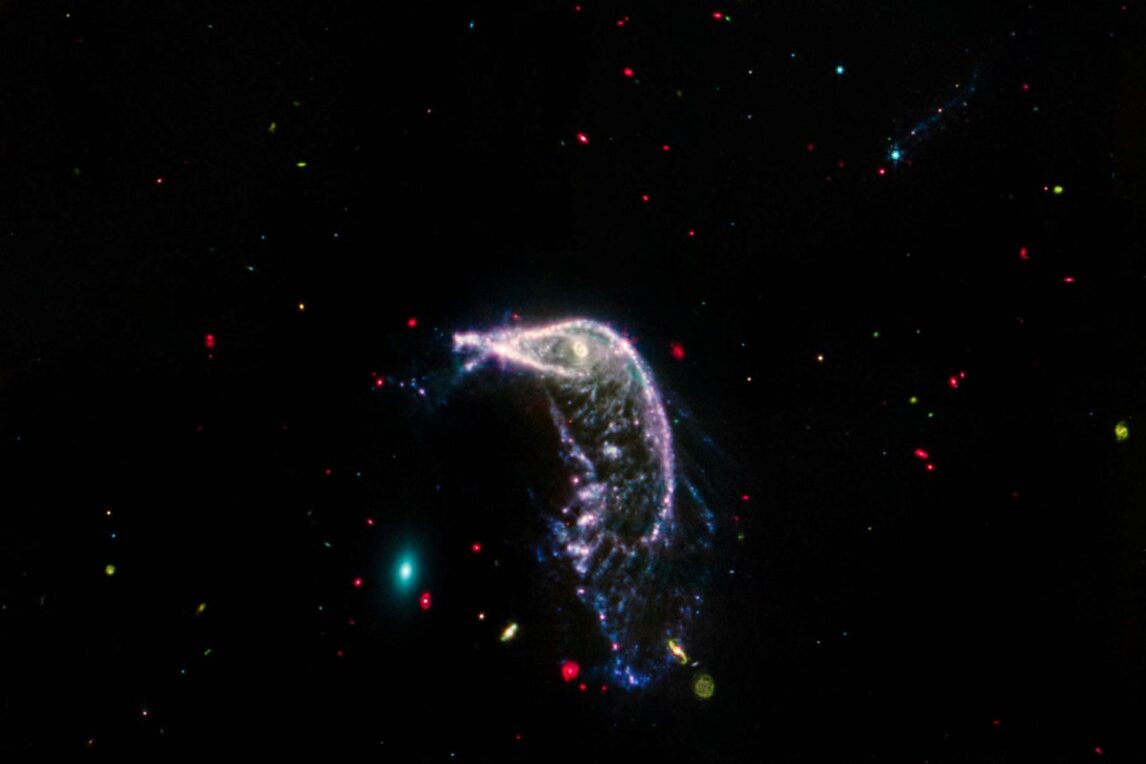
NASA celebrates two years of groundbreaking discoveries from the James Webb Space Telescope with a mesmerizing image: a cosmic ballet of two galaxies merging.
Read: Bandwidth Blog & Smile 90.4FM Tech Tuesday: Voyager 1 still going!
The image, captured 326 million light-years away in the constellation Hydra, showcases the Penguin Galaxy (NGC 2936) and the Egg Galaxy (NGC 2937), now known collectively as Arp 142. Their whimsical nicknames reflect their shapes as seen by Webb’s powerful infrared gaze.
“These galaxies are waltzing in a slow-motion merger,” explains Jane Rigby, NASA Webb senior project scientist. “This is a common way galaxies like our own Milky Way grow, by merging with smaller neighbours.”
Webb’s unparalleled capabilities allow us to peer back in time, observing galaxies brimming with stars formed just a few hundred million years after the Big Bang. The hazy region between the Penguin and Egg is a swirling mix of gas and stars churned by their gravitational dance.
The distorted Penguin Galaxy, once a majestic spiral, and the compact elliptical Egg Galaxy are predicted to become one within hundreds of millions of years. This galactic collision sets the stage for the formation of new stars and potentially even planets.
Webb’s achievements extend far beyond this captivating image. It has unveiled the earliest known galaxies, peered into the atmospheres of distant exoplanets, and shed light on the composition of objects hidden behind dust clouds.
“Webb has revolutionized our understanding of the early universe,” says Mark Clampin, astrophysics division director at NASA headquarters. “These newly discovered galaxies are surprisingly massive and bright, forcing us to re-evaluate how they formed so quickly.”

Webb, designed to succeed the Hubble Space Telescope, observes the universe primarily in infrared light, invisible to our eyes. This allows it to pierce through dust and gas, revealing the cosmos in a whole new way.
“Webb’s power lies in its ability to see the universe in infrared,” explains Clampin. “This lets us peer back further in time, witness the birth of stars, and analyse the atmospheres of alien worlds. The possibilities for future discoveries are truly endless.”
As Webb continues its groundbreaking journey, we can only imagine the awe-inspiring cosmic insights yet to be revealed.
