

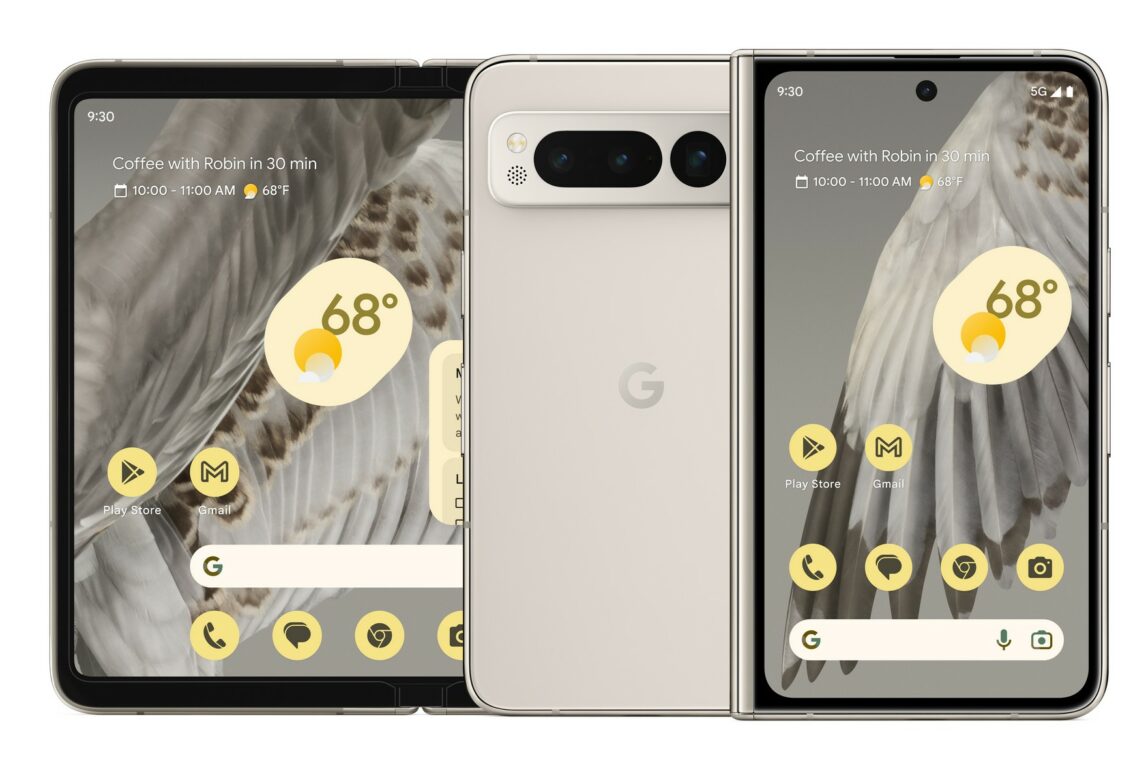
As has been the case over the last several years, Google had already unveiled it’s newest flagship about a week before the official launch. It seems Google is the worst tech company when it comes to keeping its products secret before launch and are especially susceptible to leaks, but now we have full details. The Google Pixel Fold is the company’s first foldable, running last year’s Tensor G2 chipset and selling for $1,799. That is a steep ask, especially since some other good foldables are now available for significantly less than that.
Read: Elon Musk names Linda Yaccarino new Twitter CEO

While the Pixel Fold is more expensive than earlier reports suggested, its hardware is mostly what we expected. It features a tall 5.8-inch external display and a wide 7.6-inch internal screen that are both 120Hz OLED panels with HDR support. The external display can get up to 1,200 nits HDR and 1,550 nits peak brightness, while the internal display can get up to 1,000 nits HDR and 1,450 nits peak brightness. The phone’s steel hinge is built with a dual-axis, quad-cam synchronized mechanism that results in a smooth opening motion. Notably, the Pixel Fold has a less prominent crease than Samsung’s Galaxy Z Fold 4, making it a better option for users looking for a more seamless folding experience.
Google’s pitch for the foldable is similar to Samsung’s: it allows users to complete quick business on the front screen and then open up the device for a tablet-like experience. However, the ability to fold the phone also allows for innovative features, such as being able to watch a YouTube video on the top half with playback controls on the bottom. Google also previewed features that take advantage of both screens simultaneously, like being able to show translated text on the external screen while entering queries on the other side.

While the Pixel Fold’s hardware is not entirely new, it marks a significant step for Google, a company that has traditionally played it safe in the mobile market. The device is essentially a flexible version of the Pixel 7 Pro, with a G2 chip and 12GB of RAM. Early adopters may be disappointed that it features last year’s hardware, but Google likely chose to release the device with older hardware to keep up with Samsung’s foldable phone offerings.

The Pixel Fold’s cameras are a slight step back from the Pixel 7 Pro, but they are still more impressive than those of the Z Fold 4. It features a new 9.5-megapixel external camera and an 8-megapixel internal shooter, while the rear setup boasts a 48-megapixel main camera, a 10.8-megapixel ultra-wide, and a 10.8-megapixel telephoto camera with 5x optical zoom. The 7 Pro had a 50-megapixel Quad Bayer main camera, a 12-megapixel ultra-wide lens, and a 48-megapixel Quad Bayer telephoto. Even the front camera was slightly more impressive at 10.8 megapixels.

The phone’s thinness – it measures 6mm when opened and 12.1mm when closed – is a major reason for the lower-spec sensors. Google was likely limited by the available camera sensors for slim devices. Although a company’s pursuit of thinness may not always be desirable, in the case of the Pixel Fold, it helps balance the device’s weight, which is slightly heavier than the Z Fold 4 at 10 ounces. However, the weight distribution makes it feel less dense, according to Sam’s hands-on. Overall, while the Pixel Fold may not have the latest hardware, it offers innovative features and a seamless folding experience that is sure to appeal to early adopters. Hopefully we can get hands on the Pixel Fold soon to take it for a proper test drive.
