

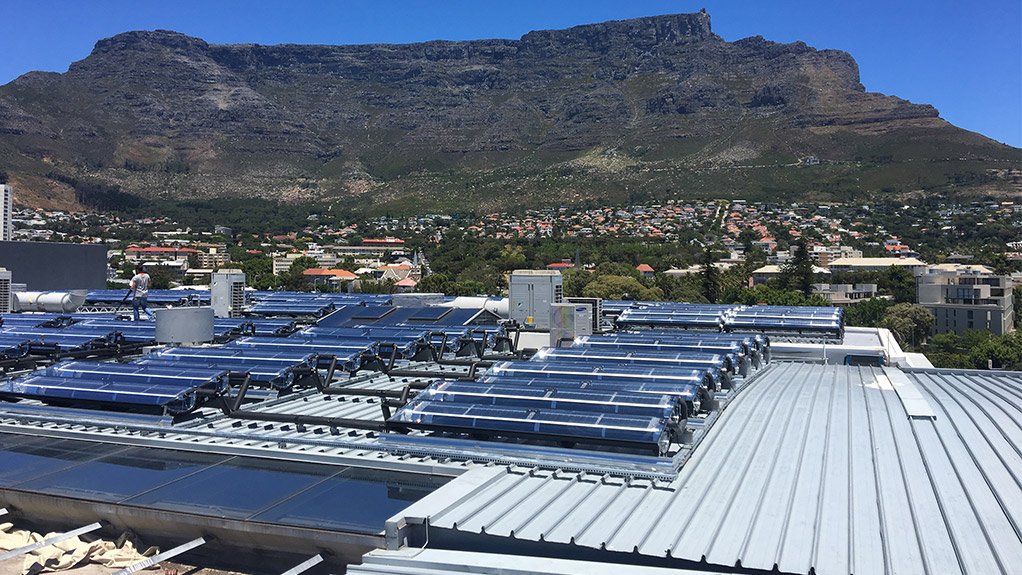
National Treasury has approved the City of Cape Town to now be able to pay cash for power fed into the local electricity grid. The system will launch to local businesses first, and become available to Cape Town residents soon thereafter, although no timelines have been announced. The main goal is to give Cape Town residents four stages of loadshedding protection, meaning that the grid in Cape Town will be four stages lower than the rest of the country if loadshedding persists.
Read: Bandwidth Blog & Smile 90.4FM Tech Tuesday: Security drone
Cape Town has been exempted from the competitive bidding processes by National Treasury, which was not designed for “the coming energy revolution”, according to the mayor, Geordin Hill-Lewis.
“Payments to commercial customers will be possible before June, and within the year for any Capetonian with the necessary City-approved generation capacity,” Hill-Lewis said. “If you’re thinking of investing in a solar system, it just got more attractive.”
“These customers may now produce as much power as they can from their approved systems and feed it into Cape Town’s grid,” according to Hill-Lewis. “Under this plan, we will also pay these customers an incentive over and above the Nersa-approved tariff as they help us turn the corner on loadshedding.”
Under this new system, Cape Town will add a 25c/kWh incentive tariff over and above the rate of 78.98c/kWh, which the National Energy Regulator of South Africa (Nersa) has approved for 2023.

Cape Town has been preparing for energy independence for many years, and currently give residents relief of one or two stages as compared to the Eskom loadshedding stage. When under immense strain, like consistent stage four or higher, the city’s supply runs out, however.
In order to get their system approved and start feeding energy back into the grid, businesses and residents will need an Advance Metering Infrastructure (AMI) meter installed by the city.
“This is a bi-directional meter that allows accurate reporting of the amounts of energy consumed and generated,” the city said. “We know this meter is still too costly for many, and we are working on finding an alternative option of comparable quality and reliability.”
