

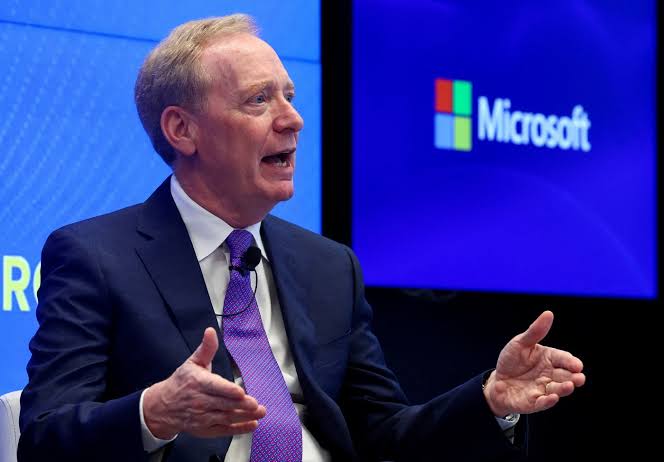
In a recent interview with ITV, Microsoft President Brad Smith highlighted the sharp contrast between the stringent regulatory oversight applied to everyday household items and the minimal safety frameworks surrounding artificial intelligence. He noted that common grocery items like milk cartons and home appliances such as washing machines face rigorous inspections and safety rules, whereas advanced AI systems, capable of executing complex cyberattacks against corporations and state infrastructure, operate with far fewer regulatory constraints.
Read: ASUS ROG Zephyrus Duo Review: Two-screen titan
While major AI developers including Anthropic, OpenAI, and Google’s DeepMind have publicly advocated for a more measured deployment pace, US policy direction under President Donald Trump has prioritized rapid acceleration to maintain a technological edge over international competitors, specifically China.
Under this approach, the administration has favoured voluntary industry commitments over binding government mandates. At a recent Super Intelligence summit, high-profile technology leaders—including Google CEO Sundar Pichai, Anthropic CEO Dario Amodei, Meta CEO Mark Zuckerberg, OpenAI President Greg Brockman, Tesla and xAI CEO Elon Musk, and NVIDIA CEO Jensen Huang—signed a voluntary accord. The agreement focuses on self-regulation, implementing technical safeguards to prevent frontier models from behaving unpredictably, and utilizing independent third-party auditors for safety assessments.
However, industry analysts and policy critics have dismissed the accord, arguing that allowing technology companies to establish their own safety metrics creates a conflict of interest and serves primarily as a distraction from meaningful regulatory oversight.
Smith suggested that the absence of federal AI legislation in Washington presents a distinct opportunity for the United Kingdom to establish a leading role in global technology governance. Observing that British regulatory efforts are viewed differently by American policymakers than the framework established by the European Union in Brussels, Smith framed the current landscape as a critical moment for international intervention. With frontier models advancing to levels that could compromise global cybersecurity, he emphasized that the window for establishing comprehensive, enforced safety standards is rapidly closing.
