

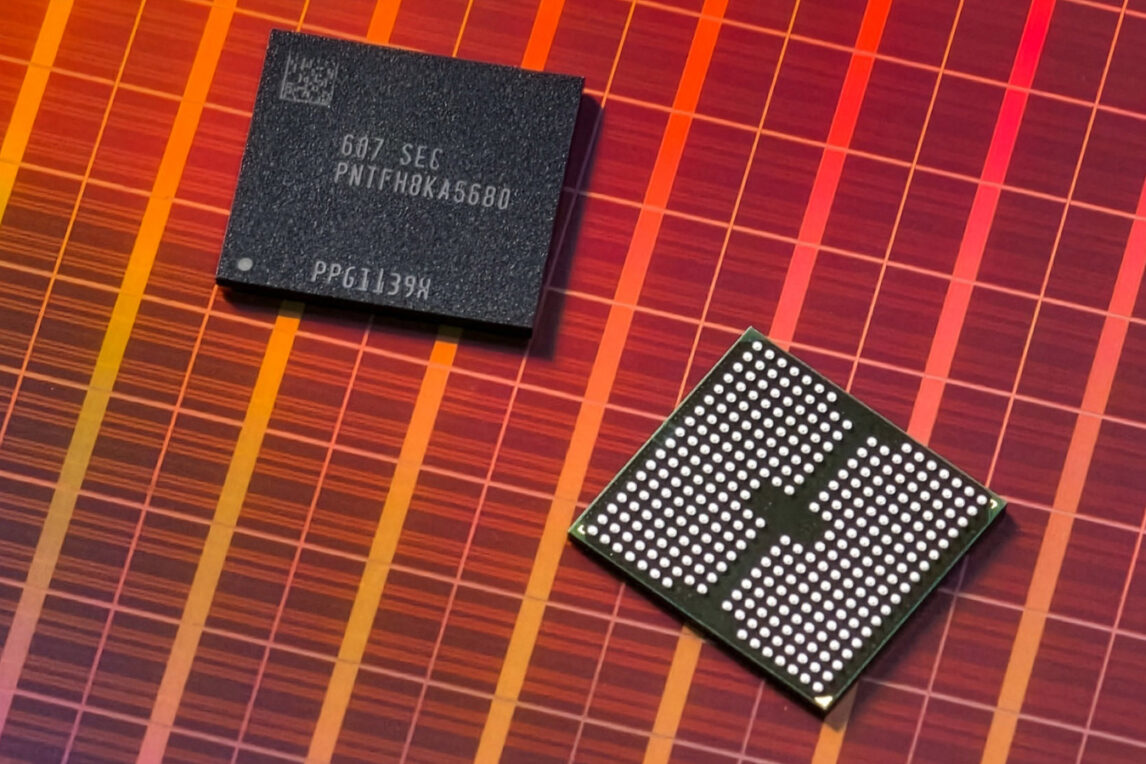
There was a time when Samsung’s memory and storage announcements directly heralded faster boot times and snappier file transfers for everyday PC users. While the tech titan’s latest semiconductor breakthroughs unveiled at the Future of Memory and Storage (FMS) show in Santa Clara are undeniably impressive, the reality of today’s market means the vast majority of this silicon will be absorbed by AI data centres rather than consumer rigs.
Read: WalletDoc to be acquired by Capitec for R400 million
The highlight of Samsung’s showcase was its zHBM concept architecture, designed specifically for AI accelerators, data centres, and specialized enterprise GPUs. Unlike conventional configurations that place memory alongside the processor, zHBM vertically stacks memory directly on top of the accelerator. This vertical integration delivers up to an eightfold boost in performance. Leveraging next-generation wafer-bonding technology, zHBM offers over ten times the memory density of current HBM5 standards while improving energy efficiency three times over.
On the storage front, Samsung introduced its V10 BV-NAND architecture, designed for next-generation solid-state drives (SSDs) and flash storage. By utilizing a new bonding V-NAND design, Samsung stacked over 400 layers of memory cells, resulting in:
- A 58% increase in memory density compared to the previous V9 generation.
- Significant improvements in read and write throughput.
- Faster input/output (I/O) processing speeds.

Samsung also targeted localized processing with zNAND-O, a low-latency V-NAND solution tailored for edge AI environments that demand high space efficiency and rapid I/O speeds. Additionally, the company showcased its LPDDR5X-PIM, the industry’s first mobile memory featuring Processing-in-Memory technology. By handling computational tasks directly within the memory modules, LPDDR5X-PIM drastically reduces data transfer overhead and optimizes power consumption.
Together with SK Hynix, Samsung controls the vast majority of global memory production. As both manufacturing giants struggle to keep pace with the massive demand driven by the AI infrastructure boom, supply constraints continue to ripple across the consumer market. This relentless enterprise appetite has driven up costs across the board, pushing prices higher for consumer electronics, including smartphones, laptops, and gaming consoles.
