

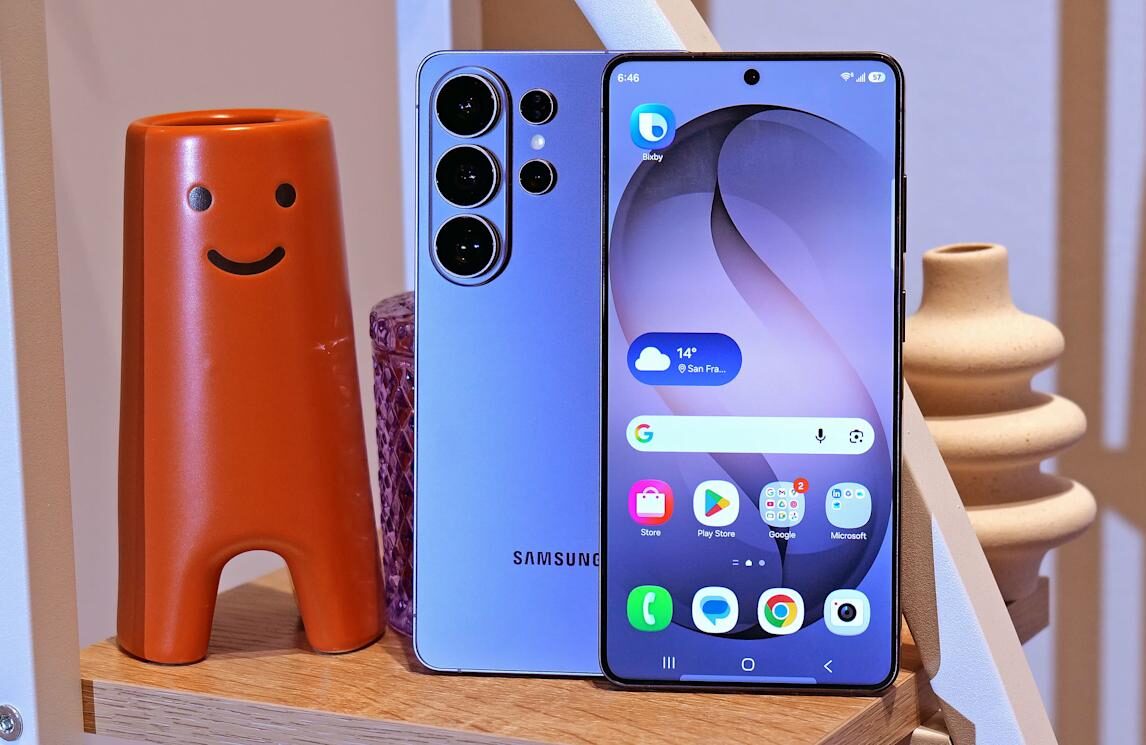
While the previous generation relied heavily on the novelty of artificial intelligence to drive upgrades, the Galaxy S26 Ultra represents a return to form for Samsung’s hardware engineering. The 2026 flagship successfully balances a suite of machine-learning enhancements with significant physical upgrades, including a more ergonomic chassis, faster charging, and a pioneering display technology. Despite global component shortages and a shift in material choices, Samsung has maintained a steady entry price of $1,300, making the new Ultra a more comprehensive value proposition than its predecessor.
Read: Samsung launches Galaxy S26 and S26+ with refined design
The silhouette of the Ultra series remains intentionally “boxy,” yet the S26 Ultra introduces a softer, more refined feel through slightly rounded corners. In a notable departure from the titanium trend, Samsung has opted for an Armor Aluminium chassis. This change allows for better colour matching between the frame and the rear panel and brings the Ultra’s aesthetic closer to the rest of the S26 family.
The device is officially the thinnest and lightest Ultra produced to date, weighing 214 grams with a thickness of 7.9mm. While the reduction from the previous model (218g and 8.2mm) is statistically significant, the real-world ergonomic benefit is subtle. The phone debuts in a “hero” shade of Cobalt Violet, alongside Sky Blue, White, and Black, with Silver Shadow and Pink Gold reserved as online exclusives.
The standout hardware innovation for 2026 is the Privacy Display. Inspired by integrated laptop privacy screens, this feature prevents unauthorized viewing from side angles or from above and below. The implementation is highly intelligent; it can be programmed to activate automatically when the system detects a password prompt, or it can be toggled by specific applications and notifications.
Crucially, this added security layer does not compromise the visual experience for the primary user. The 6.9-inch AMOLED panel retains its 120Hz variable refresh rate and 2,600-nit peak brightness. When viewed head-on, the only discernible difference is a negligible dip in overall luminosity, ensuring that the flagship viewing experience remains intact.
Internally, the S26 Ultra is powered by the Snapdragon 8 Elite Gen 5 for Galaxy, paired with either 12GB or 16GB of RAM. The performance gains are substantial across the board:
- NPU (Neural Processing Unit): 39% faster, driving the device’s advanced AI tasks.
- GPU (Graphics Processing Unit): 24% increase in rendering speeds for high-end gaming.
- CPU (Central Processing Unit): 19% improvement in general processing.
Charging speeds have also seen a long-overdue boost. Wired charging is now rated at 60W (up from 45W), and wireless charging has increased to 25W when used with compatible Qi2 pads. To support these higher speeds, Samsung includes a 3-amp cable in the box. However, the device notably lacks an internal magnetic ring; users wishing to utilize magnetic accessories must still rely on specialized third-party cases.
Samsung has addressed criticisms regarding hardware stagnation by significantly widening the apertures on the S26 Ultra’s primary lenses. While the 200MP main sensor and the 50MP 5x telephoto lens retain their previous resolutions, their apertures have moved to f/1.4 and f/2.9, respectively. This allows for 47% more light to reach the main sensor, promising a dramatic leap in low-light “Nightography” and natural depth of field.

Video capabilities have been expanded with support for the APV codec at 8K/30 fps. Furthermore, a new 360-degree horizon lock feature allows the phone to be rotated entirely during recording while keeping the footage perfectly level. This level of stabilization, combined with AI-driven noise pattern recognition, positions the S26 Ultra as a serious tool for mobile creators.
The 2026 AI suite moves beyond simple image editing toward true utility. The most impressive addition is Automated App Actions. Integrated with Gemini, this feature allows users to issue complex, multi-step commands, such as ordering a specific Uber, and then return to other tasks while the AI completes the transaction in the background. A final notification prompts the user to review and confirm the action before it is finalized.
Other software refinements include Now Nudge, which suggests contextually relevant actions or photos within the Samsung keyboard, and an AI-powered Gallery that automatically categorizes screenshots into eight distinct folders for easier retrieval.
The Galaxy S26 Ultra is a disciplined upgrade. By focusing on display privacy, aperture size, and charging velocity, Samsung has provided tangible reasons to choose the Ultra over its smaller siblings. While the S-Pen remains largely unchanged, the overall package feels cohesive and future-proof.
Pre-orders for the Galaxy S26 Ultra are currently open, with official retail availability set for March 11.
