

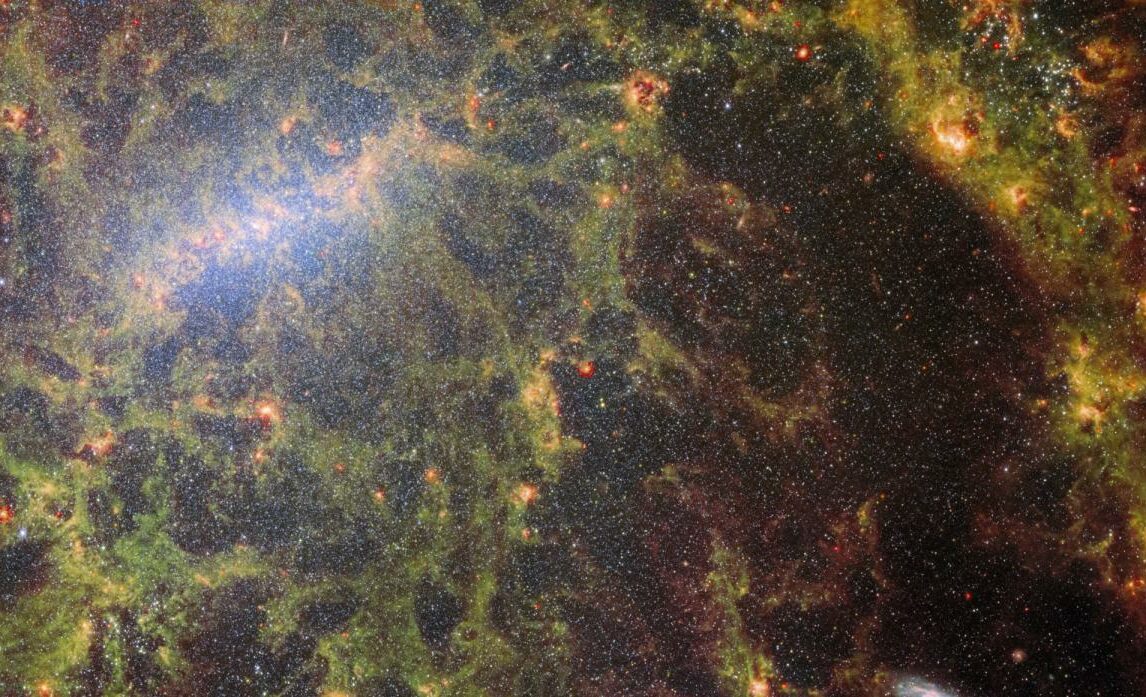
NASA, the European Space Agency (ESA), and the Canadian Space Agency (CSA) regularly astonish us with breath-taking images captured by the James Webb Space Telescope. The latest addition to this visual marvel is a captivating portrayal of the barred spiral galaxy NGC 5068, which is a massive cradle for new starts being born.
Read: Huawei FreeLace Review: Quirky tunes, questionable beats
This galaxy earns its “barred” classification due to the prominent central bar visible in the upper left section of the composite image. The composite itself combines infrared shots obtained from the MIRI (Mid-Infrared Instrument) and NIRCam (Near-Infrared Camera) sensors of the telescope.
NGC 5068 resides in the Virgo constellation, situated approximately 20 million light-years away from our planet. The James Webb Space Telescope possesses the remarkable ability to penetrate the cosmic dust and gas that envelop stars during their formation. This makes it particularly suited for capturing images that unravel the intricate process of star birth.
By scrutinizing the individual images that constitute the composite, we gain insight into different aspects of the galaxy. The MIRI sensor image provides a glimpse into the galaxy’s structure, accentuated by glowing gas bubbles that symbolize recently formed stars. On the other hand, the NIRCam image directs our attention to a vast array of foreground stars. The composite image, as a whole, conveys both the sheer multitude of stars within the region and the dazzling radiance of these new-born celestial objects.
Although this particular image does not present a specific ground-breaking discovery, it contributes to NASA’s broader mission of amassing a rich collection of images showcasing star formation processes within nearby galaxies. NASA has previously shared other impressive images, such as the “Phantom Galaxy” revealed last summer, emphasizing the significance of comprehending star birth phenomena.
The ultimate objective of these observations is to deepen our understanding of star formation, which serves as a foundation for numerous disciplines within the realm of astronomy. From unravelling the physics of interstellar plasma to exploring the evolution of entire galaxies, star formation holds profound implications. NASA anticipates that the data collected from galaxies like NGC 5068 will serve as catalysts for major scientific advancements, although the precise nature of these breakthroughs remains a tantalizing mystery.
