

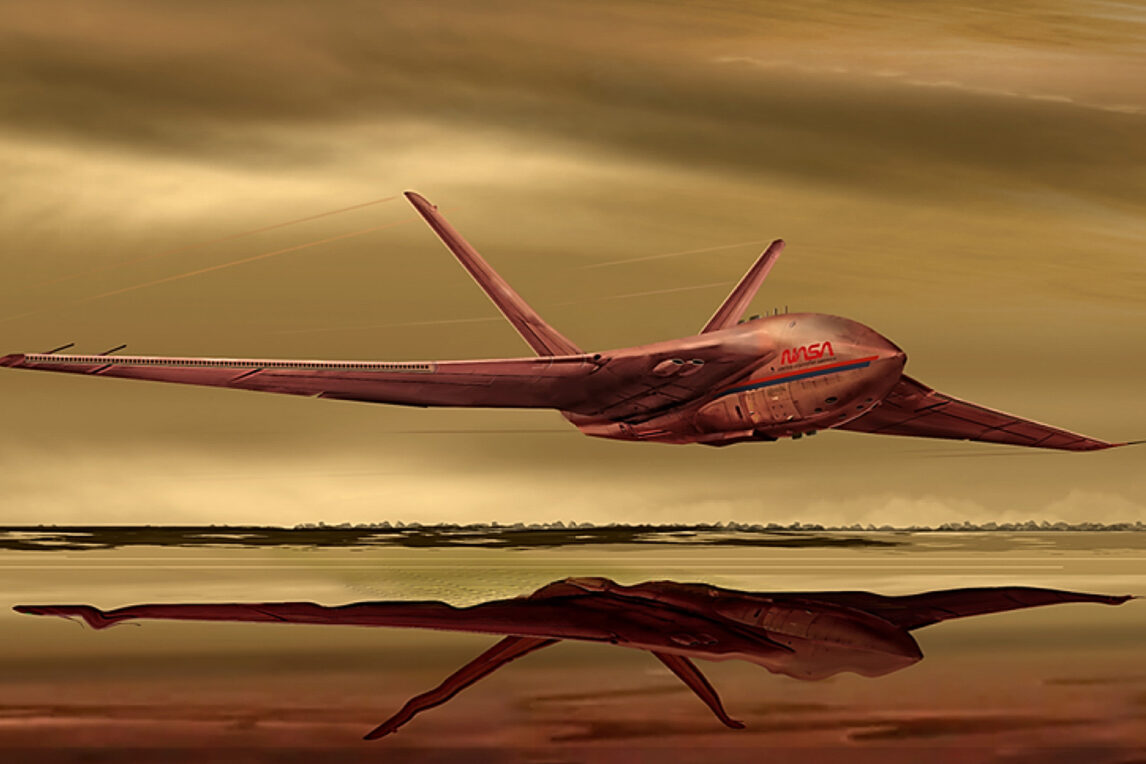
NASA still has (admittedly less) budget to fund unusual concepts with the mission of advancing space exploration. This year the space agency has handed out $175,000 in study grants to fourteen different projects, which could prove vital for missions in and beyond our solar system. Titan Air is one of these funded projects, which is a seaplane that could both fly through the nitrogen-and-methane atmosphere of Saturn’s moon Titan and sail its oceans.
Read: The Withings urine scanner lives in your toilet
The Titan Air is a ‘flying boat’ that could collect methane and complex organic material for study by sucking it in through the leading edge of the wings.
Some other notable projects include a new transit method which could speed up missions to the outer edge of the Solar System and even interstellar space. Designed by Artur Dayovan at UCLA, it could propel spacecraft by producing a “pellet-beam” of microscopic particles travelling at very high speed using laser blasts. The study found that it could dramatically shorten the time it takes to explore deep space. Voyager 1 took 35 years to reach interstellar space, which is measured at 123AU (astronomical units, or the distance from the Sun to Earth). A one-ton spacecraft using this technology could reach 100AU in three years, and could travel 500AU in 15 years.

Another proposal from MIT involves a deep space observatory that would use a swarm of thousands of tiny satellites to detect low-frequency radio emissions from the early universe, not to mention the magnetic fields of Earth-like exoplanets. A project from the University of Nebraska was also chosen, which would use self-growing habitat building blocks that could save space on missions to Mars.
As always, these are nowhere near to fruition yet, with the funding meant to go towards additional studies and concepts that could make the projects viable.
