


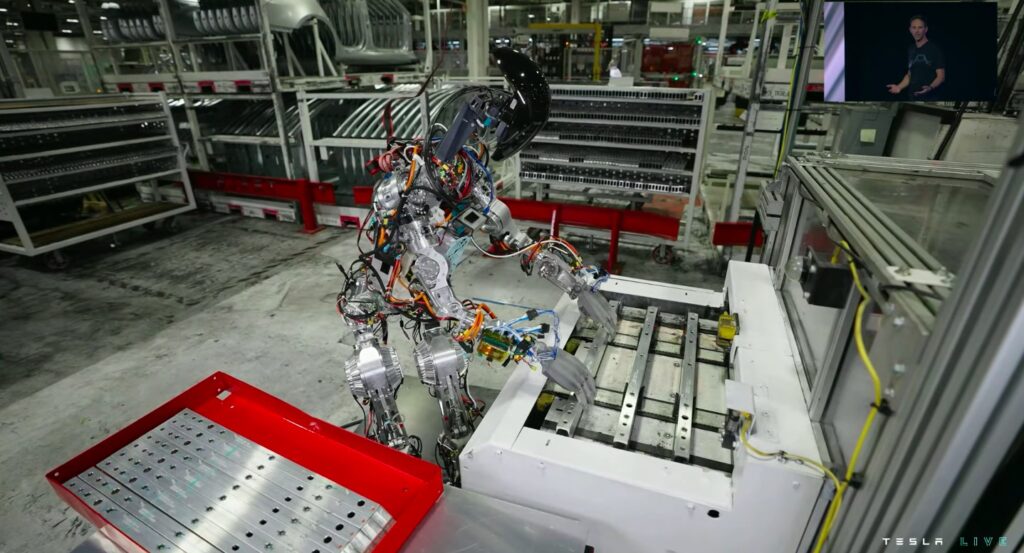
When Elon Musk announced the robot his company is building at Tesla AI Day 2021, the specimen was simply a gig worker in a spandex suit. So many wondered what would be announced at this year’s event. At this year’s Tesla AI Day, Elon Musk unveiled the new iteration of its Optimus robot, showing off how it uses the same technology used for its self-driving cars.
Read: MTN is not happy with Telkom over Rain talks
Going from a skinny guy in a suit to an actual working prototype in a year is good doing by any measure – the team has been hard at work. The Tesla Optimus will operate an AI similar to the company’s Autopilot system and be capable of working safely around humans without extensive prior training. The main aim is to absolve humans from doing menial, boring, repetitive work.
The new machine will also understand complex verbal demands, use “human-level hands”, be able to move at nearly 10 km/h and carry up to 20 kg. It is around 6 feet tall and currently weighs less than 60 kg. Here is a summary video of the event and what the Tesla Optimus can do:
“Our goal is to make a useful humanoid robot as quickly as possible,” Musk said. “And we’ve also designed it using the same discipline that we use in designing the car, which is to say… to make the robot at a high volume at low cost with higher reliability.” He also said that they could cost under $20,000 when built at volume.
“Humans are also pretty efficient at somethings but not so efficient at other times,” Lizzie Miskovetz, a Senior Mechanical Design Engineer at Tesla, and a member of the engineering team explained. While humans can sustain themselves on small amounts of food, we cannot halt our metabolisms when not working.
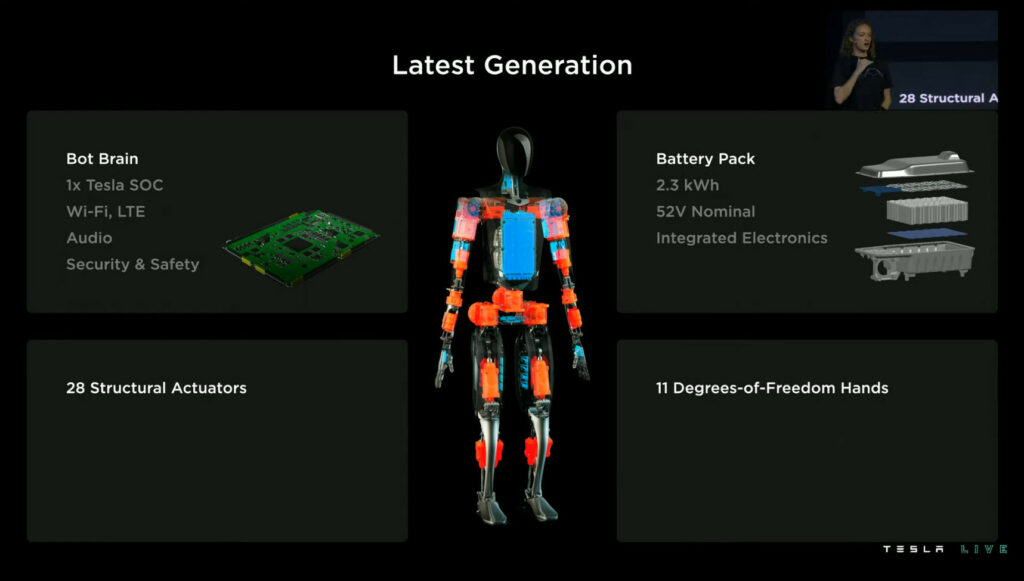
“On the robot platform, what we’re going to do is we’re going to minimize that. Idle power consumption, drop it as low as possible,” she continued. The team also plans to strip as much complexity and mass as possible from the robot’s arms and legs. “We’re going to reduce our part count and our power consumption of every element possible. We’re going to do things like reduce the sensing and the wiring at our extremities,” Miskovetz said.
