

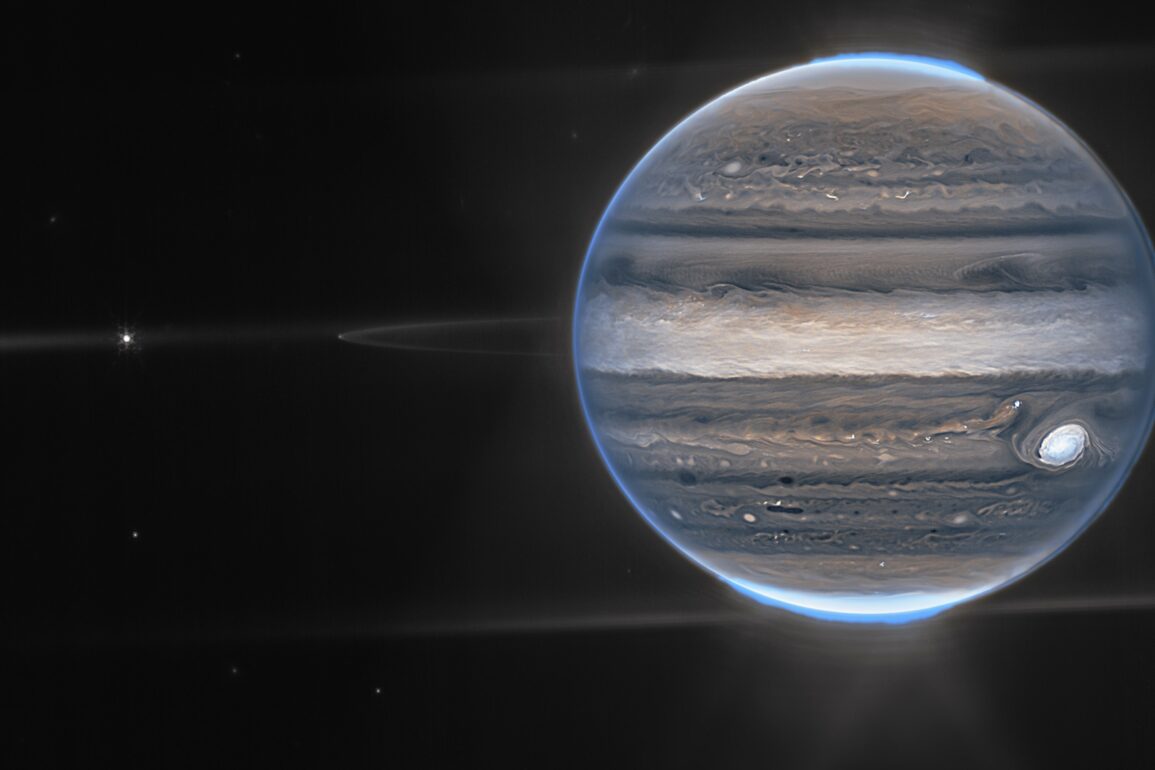
Nasa’s James Webb Space Telescope (JWST) has captured stunning new images of the largest planet in the solar system, Jupiter. The observations will give scientists even more clues to Jupiter’s inner life. It highlights a lot of new details within the mammoth planet, including giant storms, powerful winds, auroras, and extreme temperature and pressure conditions.
Read: Competition: Comic Con Tickets – 10 x General Access + Photo Ops Giveaway
“We hadn’t really expected it to be this good, to be honest,” said planetary astronomer Imke de Pater, professor emerita of the University of California, Berkeley. De Pater led the observations of Jupiter with Thierry Fouchet, a professor at the Paris Observatory, as part of an international collaboration for Webb’s Early Release Science programme. Webb itself is an international mission led by Nasa with its partners ESA (European Space Agency) and CSA (Canadian Space Agency). “It’s really remarkable that we can see details on Jupiter together with its rings, tiny satellites and even galaxies in one image,” she said.
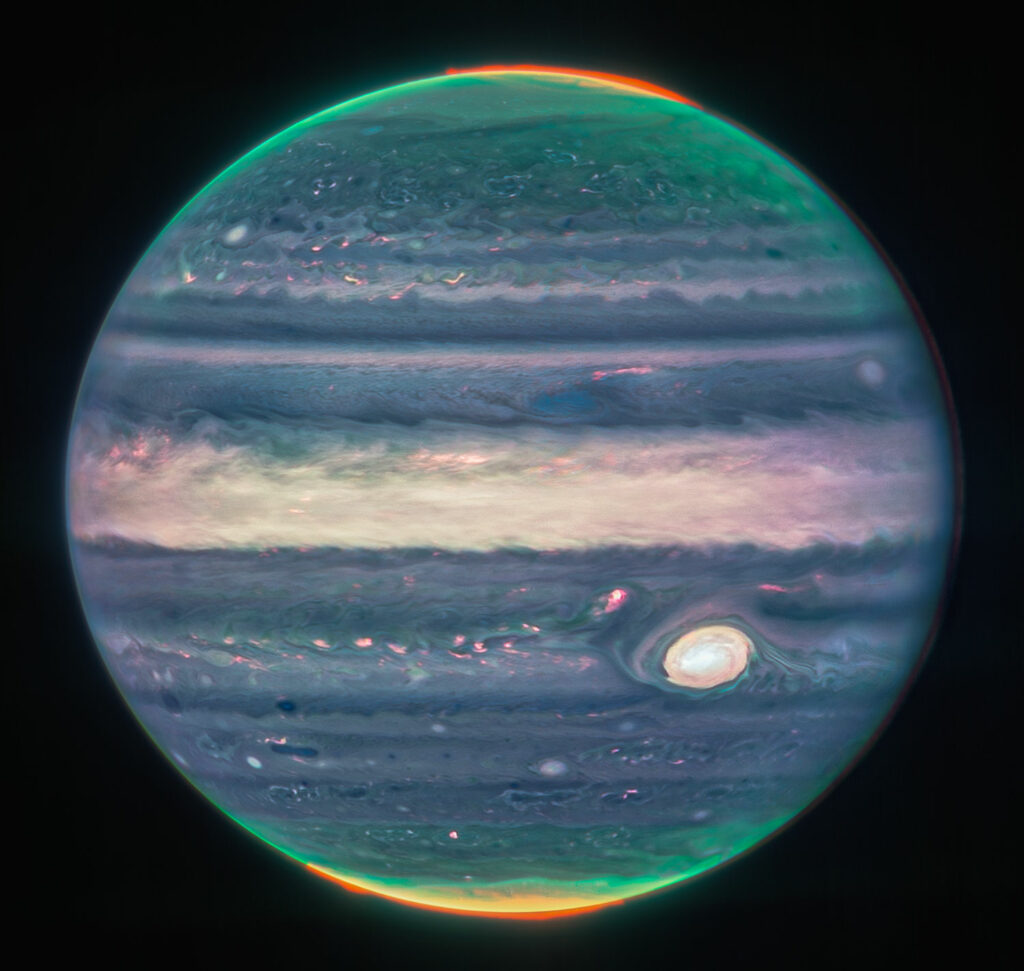
The images were captured by the JWST’s Near-Infrared Camera (NIRCam), which has three specialised infrared filters that showcase details of the planet. Since infrared light is invisible to the human eye, the light has been mapped onto the visible spectrum. Generally, the longest wavelengths appear redder and the shortest wavelengths are shown as bluer. Scientists collaborated with citizen scientist Judy Schmidt to translate the Webb data into images.

The Great Red Spot, a famous storm so big it could swallow Earth, appears white in these views, as do other clouds, because they are reflecting a lot of sunlight.

“The brightness here indicates high altitude – so the Great Red Spot has high-altitude hazes, as does the equatorial region,” said Heidi Hammel, Webb interdisciplinary scientist for solar system observations and vice president for science at Aura. “The numerous bright white ‘spots’ and ‘streaks’ are likely very high-altitude cloud tops of condensed convective storms.” By contrast, dark ribbons north of the equatorial region have little cloud cover.
